Concepts
Understanding the sprint report
A closed sprint’s report gives what it delivered, frozen at closing, and breaks its tickets down by status, type, assignee and priority. Each part leads to the list of tickets in it.
A sprint has its report as soon as it is closed. Closing the sprint opens it right away. Later, find it from Reports in the sidebar, with Sprint report next to the sprint. Any project member can view it, Viewers included.
The header gives the sprint’s name, its period and when it was closed, for example “Closed on September 10, 2026 at 6:00 PM”.
The summary
Link to the “The summary” sectionThree tiles repeat those of the closing window: tickets done, unfinished and points delivered. They do not all say the same thing, and each one carries its own mention.
The points delivered are frozen at closing. This is the sum of the points of the tickets done at that moment, the one that counts in velocity. Re-estimating a ticket afterwards does not change it.
The tickets done tile carries the mention today: it counts the tickets that are in the closed sprint when you read the report, and changes if one of them is reopened later. It also follows the workflow: a status added to the right of the last column brings it down. Unfinished carries the mention at the close: it counts the tickets that were not completed when the sprint was closed, gone since to the next sprint or the backlog. For a sprint closed before October 3, 2026, this count still describes the sprint as it is today, and is usually zero.
The tickets of the sprint
Link to the “The tickets of the sprint” sectionUnder the summary, as in Jira’s sprint report, three lists name the tickets:
- Tickets completed: completed at the close.
- Tickets not completed: present at the close and not completed, so carried over to the next sprint or the backlog.
- Tickets removed from the sprint: taken out of the sprint while it was running.
An empty list is not shown. A ticket that entered the sprint after its start carries an asterisk (*). Each ticket appears once, in the list that says what became of it. A ticket deleted since, or that you can no longer see, keeps its line without its key. Each list exports with Export as CSV.
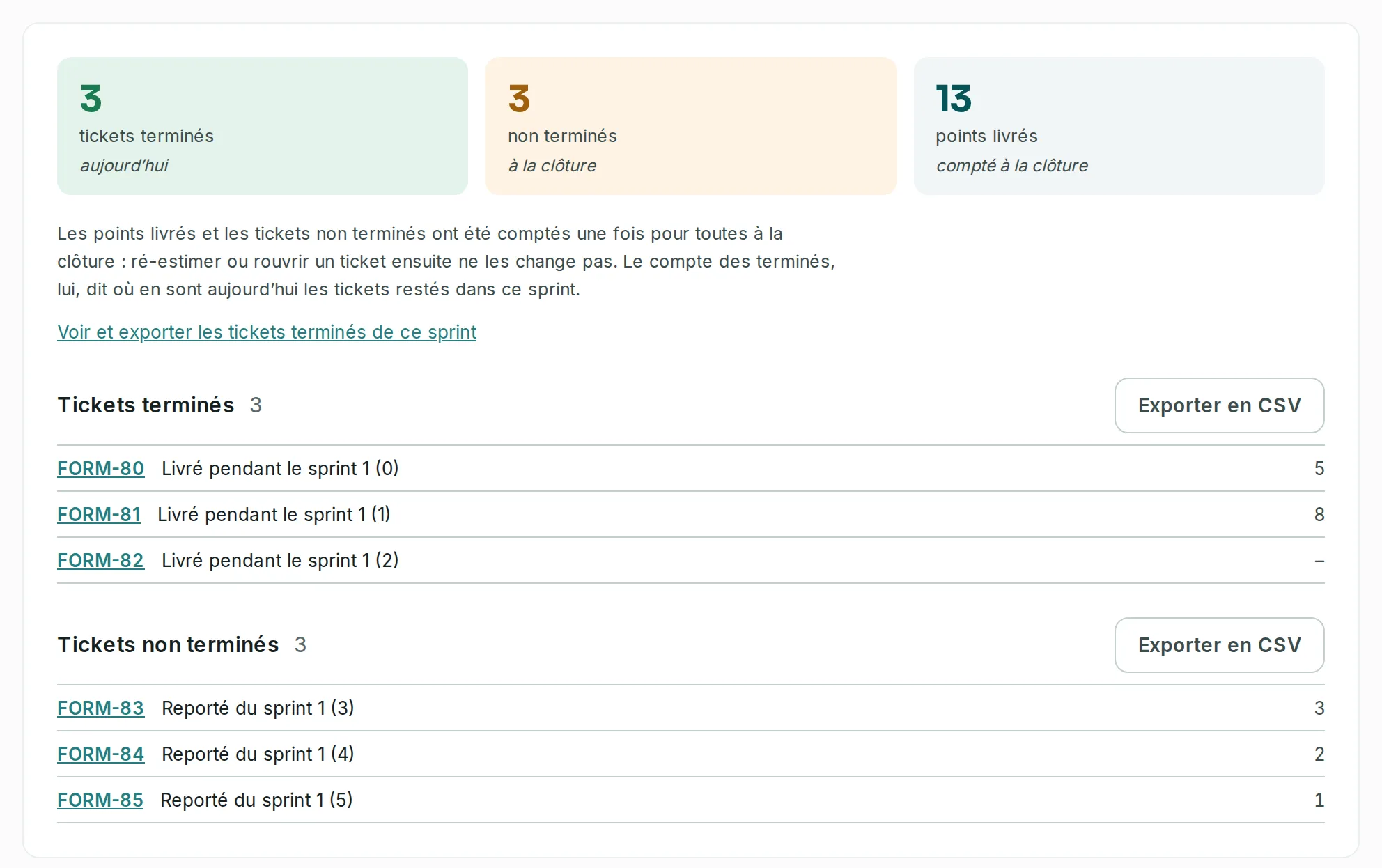
These lists exist for sprints closed from October 3, 2026: a sprint closed before has none, the history was not kept.
A ticket’s page also shows the Previous sprints it went through.
The breakdowns
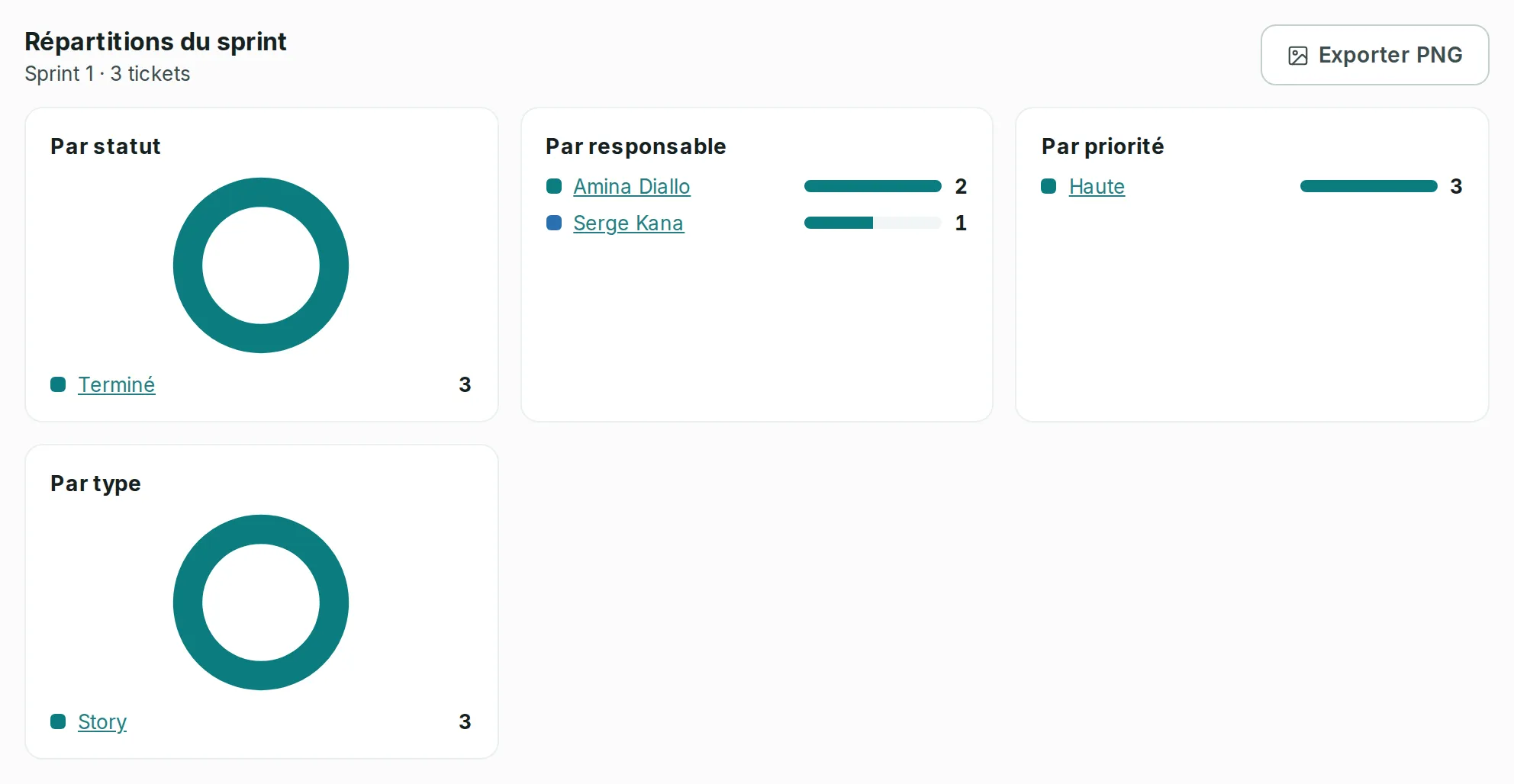
Link to the “The breakdowns” sectionUnder the summary, Sprint breakdowns sorts the sprint’s tickets in four ways. The subtitle gives the sprint’s name and the number of tickets counted.
- By status and By type are drawn as rings.
- By assignee and By priority are drawn as bars.
Each part gives its number of tickets. A ticket with no value keeps its own part: Unassigned, No priority or No type. Like the two counts of the summary, the breakdowns describe the current state of the sprint’s tickets, not their state at closing. A sprint with no ticket at all shows none.
Open the tickets of a part
Link to the “Open the tickets of a part” sectionClick the name of a part. Advanced search opens, filtered on the project, the sprint and the chosen value. There you can refine the criteria, save the search with Save this filter, or download the list with Export. See Export or print tickets.
The Unassigned, No priority and No type parts cannot be clicked.
Good to know
Link to the “Good to know” section- The report of a sprint that is not closed does not show. The screen says “This sprint is not closed yet: its report will appear once the iteration is over.”
- If the report does not load, the screen shows “The sprint report could not be loaded.” followed by the cause, with Retry.
- “This sprint does not exist, or you are not a member of the project.” means that the address leads to no sprint, or that you are not a member of its project.
- Export PNG, on the right of Sprint breakdowns, downloads the breakdowns as an image. To take away the tickets of the whole sprint, open a part, remove the chip of its value with its cross in advanced search, then click Export. The file gives the status, type, priority and assignee of each ticket.